Civilization: The Expansion Project

A strategy game inspired by Advanced Civilization™


All times are UTC


Post new topic Reply to topic  [ 149 posts ]  Go to page Previous  1, 2, 3, 4, 5 ... 10  Next
New Artwork For The Civilization Advances
Author Message
Post 
Image

Quote:
01october2007 - MINING. I drew this one. Found it too dark. Too different from the rest. When I received an email about this with the same opinion I decided to draw another image for this card. scroll ahead!


november 6th 2007:
I've redone Mining. Here it is:
Image

_________________
WOH CANGHED TEH KYES ON YM KEBYORAD?


Last edited by Flo de Haan on 2007-11-06 20:58:31, edited 3 times in total.

VIP
User avatar
Profile
Send private message
Joined:
2007-06-22 22:26:30
Posts:
1053
Location:
Netherlands (Heerhugowaard)
Post 
Flo de Haan wrote:
deism
The belief that God exists but is not involved in the world. Superstition in the religious sense means "fear of God"
Current art to be redrawn


You are correct in that this is the current definition of the word, but I suspect that this card refers to the earlier meaning which meant belief in a god or gods for which we now use the word Theism. Any other opinions?


Last edited by BWR on 2007-09-21 12:32:23, edited 2 times in total.

Senior Member
Profile
Send private message
Joined:
2003-03-31 11:40:37
Posts:
79
Location:
Central California USA
Post 
OK. I did not read every single reaction on every single topic on this forum. But has there been any discussion about this before?

Deism is a very hard card to do artwork for. Has there been any voting for this card to be called "theism" instead?

Let me know. I set this one apart for a while, maybe the same for Monotheism.

Reaction:
Quote:
Regarding your intent to use Aten for Monotheism for your new art: I think Jonno makes a good point. The recognition factor would be low. Well you're the artist so it's up to you.


My suggestion:
Quote:
monotheism
Aton was the disk of the sun in ancient Egyptian Mythology. The worship of Aten was the first attempt to Monotheism. (1353 BC). Later forms of Monotheism were advanced forms of religion which could easily convert people with a lesser form of religion.
Pharaoh Akhenaten and his family adoring the Aten


The same goes for some other cards. which moment in history do you pick.
The more study I did on each subject. The more I found out, that the timeline used in the orignal game has nothing to do with reality when it comes to the original advanced or inventions in real life.

E.G. Monotheism was first 'invented' 1353 BC, while in the game it's not a card start with.

While doing this study I first tried to get some moment in time when the card would be normally bought. But later I realized that is impossible. Same for Mining (especially now its worth 230) which goes back thousands of years.

I'd like to do some more study on Monotheism before deciding what to do.

For my set, as I explained earlier, I'm addind some flavour/explaination text on each advance for what i meant in history in real life. That is because not all players are thought to be historical experts. I also realized some advances are much more complicated or important than I thought before reading on them.


Again on Monotheism. I first thought Moses would be a good image, later I found it too concrete. You see, it wasn't the first moment of Monotheism in history. Might be the best known. Maybe we get to it eventually but I'd like to look furhter. Any suggestions?

_________________
WOH CANGHED TEH KYES ON YM KEBYORAD?


VIP
User avatar
Profile
Send private message
Joined:
2007-06-22 22:26:30
Posts:
1053
Location:
Netherlands (Heerhugowaard)
Post 
Flo de Haan wrote:
OK. I did not read every single reaction on every single topic on this forum. But has there been any discussion about this before?

Deism is a very hard card to do artwork for. Has there been any voting for this card to be called "theism" instead?


No, no voting. It could be that the original designers of the card confused Deism/Theism. But I beleive the modern concept of Deism didn't become popular until the 1700s and previously was used the way we use Theism today, not that I use it much in everyday conversation. :D


Senior Member
Profile
Send private message
Joined:
2003-03-31 11:40:37
Posts:
79
Location:
Central California USA
Post 
ha neither do I. But Deism is much older, though it has been rediscoverd in the 1700-s. As well as so many ancient developments and terminology

Maybe Theism is the right name, but as well as Orthodoxy, for now I keep the old names. could be changing it. I set Deism aside for a while, until I did some more study on it.

_________________
WOH CANGHED TEH KYES ON YM KEBYORAD?


VIP
User avatar
Profile
Send private message
Joined:
2007-06-22 22:26:30
Posts:
1053
Location:
Netherlands (Heerhugowaard)
Post 
Well, I did some research on the internet on several websites about the term and history of Deism. This was my original description of last week: "The belief that God exists but is not involved in the world. Superstition in the religious sense means 'fear of God' "
This is what I found today:

DEISM

From the Latin word, Deus, for God, Classical Deism sprang up during one of the most intellectually disruptive periods in all of human history. The period known as the Renaissance, with the rediscovery of the ancient writings of Socrates, Aristotle, Plato and others, began the process of sweeping away the fear-based mythology of the Middle Ages.

Although some Deists were naturalists, atheists, Christian, or even Muslim, there was at least one unifying characteristic of Deistic thought- the rejection of “revealed religion” in favor of a more rationalistic and reasoned approach to understanding the Divine.

(Alternate description: )"Belief in God based on Reason, Experience and Nature (nature of the universe) rather than on the basis of holy texts and divine revelation "

Deism has no founder, but a wide series of philosophers who held deistic beliefs. Early Deism was a logical outgrowth of the great advances in astronomy, physics, and chemistry that had been made by Bacon, Copernicus, Galileo, etc. It was a small leap from rational study of nature to the application of the same techniques in religion.


Quote:
(BIBLE:) Romans 1:20, "For the invisible things of him since the creation of the world are clearly seen, being perceived through the things that are made, even his everlasting power and divinity; that they may be without excuse."

The idea of trying to understand God based on nature/reason is not new. This was followed by the ancient Greeks and is even in the Bible as shown above. The forerunner of Deism was the Stoicism of ancient Greece. Deists differ from Stoics who seemed to be pantheists. (That nature is divine, etc.) Deism is not nature worship it is an appreciation of God's creation and God's glory be it a baby born from a single cell to the vast universe scientists have only begun to discover. The proof of God is the product, not some sales pitch from those claiming to talk to dead people, ghosts, spirits, etc. (revelation)

Most of us who have studied Deism come quickly across what is commonly known as “Classical Deism”

Let us look quickly as to what some of these classical Deistic beliefs are….

1. God Exists
2. Reason is the primary tool by which we seek to understand God and the Universe.
3. God Created the Universe, or caused its creation.
4. God does not interfere in the universe he created.
Quote:
(Flo: thus denies Superstition)

5. All revelations from God currently being espoused are false, but we may each still find inspiration from within ourselves.
6. There is no such thing as the “supernatural”… just things humanity may not understand as of yet.
7. God should be revered, and thanked, but never petitioned.


The get back on Superstition:

SUPERSTITION
Superstition, as of today's understanding, is thought to derive from the Latin words "super" (over, beyond) and "sto, stare" (to stand).

In keeping with the Latin etymology of the word, religious believers have often seen other religions as superstition. Likewise, atheists, agnostics, deists, and skeptics regard religious belief as superstition. From the broadest perspective, all religion is a form of superstition.
Religious practices are most likely to be labeled "superstitious" by outsiders when they include belief in extraordinary events (miracles), an afterlife, supernatural interventions, apparitions or the efficacy of prayer, charms, incantations, the meaningfulness of omens, and prognostications.
Greek and Roman pagans, who modeled their relations with the gods on political and social terms scorned the man who constantly trembled with fear at the thought of the gods, as a slave feared a cruel and capricious master. "Such fear of the gods (deisidaimonia) was what the Romans meant by 'superstition' (Veyne 1987, p 211). For Christians just such fears might be worn proudly as a name: Desdemona.


Then the original art:


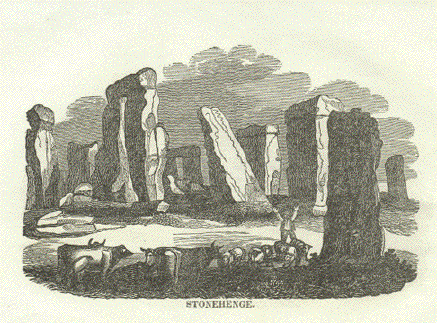
Stonehenge

Image


Many people believe that the Druids constructed Stonehenge, the complex of standing stones in South Central England. Stonehenge I ("Old Stonehenge"), which was composed of the 56 "Aubrey" holes, was constructed circa 3500 BCE. This was almost a millennium before the start of Celtic civilization. (2600 BCE.) The Druids may have preceded the Celts in England. Thus, either the Druids or their fore-runners might have been responsible for the finishing of Stonehenge and other monuments. There is no historical proof that they were or were not involved. Even if they did not actually construct these monuments, they may well have performed rituals there, and understood its astronomical meanings and uses.


(Extra: )The original Druids were wiped out by the Roman Empire and then the Roman Catholic Church.


On reading all this, I conclude:

Deism was some ancient form of religion which especially kept people away from the fear of god.(superstition). When it comes to the art. I could not think of another piece than an image of Stonehenge. The ancient druids mayhave seen the work of god/nature in Stonehenge.

When it come to the description for our game, This fits more than my original one:
Belief in God based on Reason, Experience and Nature (nature of the universe) rather than on the basis of holy texts and divine revelation.

_________________
WOH CANGHED TEH KYES ON YM KEBYORAD?


VIP
User avatar
Profile
Send private message
Joined:
2007-06-22 22:26:30
Posts:
1053
Location:
Netherlands (Heerhugowaard)
Post 
Here's my research on Monotheism. If you think it's too much to read, then my conclusion is on the bottom of this post.
Just know I read all articles on these links:

http://en.wikipedia.org/wiki/Monotheism
http://en.wikipedia.org/wiki/Moses
http://en.wikipedia.org/wiki/Zoroastrianism
http://en.wikipedia.org/wiki/Monolatrism
http://en.wikipedia.org/wiki/Henotheism
http://en.wikipedia.org/wiki/Conversion_to_Judaism
http://en.wikipedia.org/wiki/Menorah
http://en.wikipedia.org/wiki/Alexander_the_Great

The word monotheism is derived from the Greek, μόνος meaning "one" and θεός meaning "god".
The concept sees a gradual development out of notions of henotheism (to mean devotion to a single "God" while accepting the existence of other gods. ) and monolatrism. (is a form of theology where adherents believe in the existence of multiple deities but worship only one. In contrast to monotheists, monolatrists accept the existence of other gods.)
The primary difference between the two is that Monolatry is the worship of one god who alone is worthy of worship, though other gods are known to exist, while Henotheism is the worship of one god, not precluding the existence of others who may also be worthy of praise.


In the Ancient Near East, each city had a local patron deity, such as Shamash at Larsa or Sin at Ur. The first claims of global supremacy of a specific god date to the Late Bronze Age, with Akhenaten's Great Hymn to the Aten (connected to Judaism by Sigmund Freud in his Moses and Monotheism), and, depending on dating issues, Zoroaster's Gathas to Ahura Mazda. 440BCE (Zoroastrianism is the religion and philosophy based on the teachings ascribed to the prophet Zoroaster (Zarathustra, Zartosht). Mazdaism is the religion that acknowledges the divine authority of Ahura Mazda, proclaimed by Zoroaster to be the one uncreated Creator of all (God).)


While Greek and Roman religion began as polytheism, during the Classical period, under the influence of philosophy, differing conceptions emerged. Often Zeus (or Jupiter) was considered the supreme, all-powerful and all-knowing, king and father of the Olympian gods. To illustrate, Maximus Tyrius (2nd century A.D.), stated:
"In such a mighty contest, sedition and discord, you will see one according law and assertion in all the earth, that there is one god, the king and father of all things, and many gods, sons of god, ruling together with him."
The Philosophers Plato (born 428 BC)and Plotinus taught that above the gods of traditional belief was "The One".

Moses and Monotheism is a book by Sigmund Freud. It was first published in 1939. In it, Freud argues that Moses was actually an Ancient Egyptian and in some way related to Akhenaten, an ancient Egyptian monotheist.


Conversion:

Religious conversion is the adoption of a new religious identity, or a change from one religious identity to another.

In Hellenistic and Roman times, some Pharisees were eager proselytizers, ( Proselytism is the act of attempting to convert another individual from a specific religion or belief system. (See proselyte)).and had at least some success throughout the empire. Some Jews are also descended from converts to Judaism outside the Mediterranean world. It is known that some Khazars, Edomites, and Ethiopians, as well as many Arabs, particularly in Yemen before, converted to Judaism in the past

The Pharisees were, depending on the time, a political party, a social movement, and a school of thought among Jews that flourished during the Second Temple Era (536 BCE–70 CE). After the destruction of the Second Temple, the Pharisaic sect was re-established as Rabbinic Judaism — which ultimately produced normative, traditional Judaism, the basis for all contemporary forms of Judaism, including to some extent the Karaites

- The Hellenistic period of Jewish history began in 332 BCE when Alexander the Great conquered Persia. Upon his death in 323 BCE, his empire was divided among his generals. At first, Judea was ruled by the Egyptian-Hellenic Ptolemies, but in 198 BCE, the Syrian-Hellenic Seleucid Empire, under Antiochus III, seized control of Judea.

- Jews had to grapple with the values of Hellenism and Hellenistic philosophy, which were often directly at odds with their own values and traditions.

- Many Jews embraced these institutions, although Jews who did so were often looked down upon due to their circumcision, which some Gentiles viewed as an aesthetic defacement of the body. Many Jews lived in the Diaspora, and the Judean provinces of Judea, Samaria, and the Galilee were populated by many Gentiles (who often showed an interest in Judaism). Under such conditions, Jews had to confront a paradox in their own tradition: their God was the God of all, but their covenant with God — the commandments and laws through which this covenant took material and practical form — applied only to them.

- The Pharisee ("separatist") party emerged largely out of the group of scribes and sages who harked back to Ezra and the Great Assembly.

- Although the Pharisees did not support the wars of expansion of the Hasmoneans and the forced conversions of the Idumeans, the political rift between them became wider when a Pharisee suggested that the Hasmonean king Alexander Jannaeus choose between being king and being High Priest. In response, Alexander Jannai openly sided with the Sadducees by adopting their rites in the Temple. His actions caused a riot in the Temple and led to a brief civil war that ended with a bloody repression of the Pharisees, although at his deathbed the king called for a reconciliation between the two parties. Alexander was succeeded by his widow, Salome Alexandra, whose brother was Shimon ben Shetach, a leading Pharisee. Upon her death her elder son, Hyrcanus, sought Pharisee support, and her younger son, Aristobulus, sought the support of the Sadducees. The conflict between Hyrcanus and Aristobulus culminated in a civil war that ended when the Roman general Pompey captured Jerusalem in 63 BCE and inaugurated the Roman period of Jewish history.

- Orthodox Jews tend to discourage conversion, urging the person to find their path to God through being a righteous Gentile and observing the Noahide laws and living a life of kindness, but they will accept conversion if the person persists.

- A forced conversion occurs when someone adopts a religion or philosophy under the threat that a refusal would result in negative non-spiritual consequences. These consequences range from job loss and social isolation to incarceration, torture or death. Typically, such a conversion entails the repudiation of former religious or philosophical convictions.


- The menorah (Hebrew: מנורה), is a seven branched candelabrum lit by olive oil in the Tabernacle and the Temple in Jerusalem. The menorah is one of the oldest symbols of the Jewish people. It is said to symbolize the burning bush as seen by Moses on Mount Sinai (Exodus 25).

1. The Torah states that God revealed the design for the menorah to Moses. A plant that grows in Israel called the moriah typically has seven branches and resembles a menorah, leading to the theory that it provided the inspiration for its design. According to some readings, Maimonides stated that the menorah in the Temple had straight branches, not rounded as is often depicted.[3] Jewish depictions of the menorah dating back to Temple times, along with the depiction on the Arch of Titus showing the Romans taking the looted Menorah to Rome after the Temple's destruction, contradict this claim.

Image

2. A second theory to the origin of the design of the menorah is based on what is known about ancient Hebrew cosmology. According to this theory, the seven branches represent the seven heavenly bodies known at the time, namely the sun and the moon, as well as Mercury, Venus, Mars, Jupiter and Saturn. The Jewish historian Josephus alludes to this in the Third Book of his Antiquities of the Jews. In it, he identifies what he interprets as Egyptian and Greek pagan influences on the design of the Tabernacle and its contents.

3. A third theory is that the menorah originated as the tree of life symbolizing the mother goddess Asherah.[4] In the Pentateuch (Old Testament), it has been purged of all polytheistic symbolism.


CONCLUSION:


So in fact there are more ways to take a look upon Monotheism. I first chose to take the oldest form. (Egyptian Sundisc). Moses with the commandments might be good. But still that it something to believe or not. In our game it's actually about the historical meaning of Monotheism. And more specific about religeous conversion. (Mass Conversion, not personal conversion). When Monotheism in the meaning of Moses is about the belief in one god, our card has actually only to do with conversion.

Reading on Hellanization and Alexander the Great I get more to the gaming meaning of Monotheism (as well as Diaspora and Theology, and Iconoclasm). Our original card is about the historical conversion to judaism of the land previously conquered by Alexander the Great.
I'd say some image of the pharasees during the Second Temple Era (536 BCE–70 CE) is a possible image on Monotheism. But the best I guess is an image of the Menorah used in the second temple. It was used as the symbol for Judaism and as I quote: "In the Pentateuch (Old Testament), it has been purged of all polytheistic symbolism" And there you have it. The perfect symbol for Monotheism.

Image

_________________
WOH CANGHED TEH KYES ON YM KEBYORAD?


VIP
User avatar
Profile
Send private message
Joined:
2007-06-22 22:26:30
Posts:
1053
Location:
Netherlands (Heerhugowaard)
Post 
Then back to Theology. (The game's defense to Monotheism.)

Quote:
Study on religion is the weapon to any religeous conversion based on lack of knowledge.


The Expansion Project includes Diaspora (In the game regaining terrain that was previously conquered, or just expanding)

There were some votes on Fundamentalism to be recalled as Orthodoxy.

Quote:
Fundamentalism represents cultures that were antagonistic and not tolerant of other religions.


Now I don't believe Orthodoxy is the right term for a card that destructs units.

Wikipedia:
Quote:
The word orthodoxy, from the Greek ortho ('right', 'correct') and doxa ('thought', 'teaching', 'glorification'), is typically used to refer to the correct worship or the correct theological and doctrinal observance of religion, or other forms of intellectual activity shared by organizations or movements, as determined by some overseeing body.


For now I keep the name "Fundamentalism". Are there any idea's

_________________
WOH CANGHED TEH KYES ON YM KEBYORAD?


VIP
User avatar
Profile
Send private message
Joined:
2007-06-22 22:26:30
Posts:
1053
Location:
Netherlands (Heerhugowaard)
Post 
Image

Quote:
EXTRA on september 22: Besides the fact I don't like my first image on Universal Doctrine (Dead Sea Scrolls) I made a mistake on that. The Images on the DSS that can be found now are offcourse all eroded ones. The original were "NEW"
So I'm redoing that art now. look below.


ANATOMY
ART EXPLANATION
The egyptians were the first to describe human anatomy. I've chosen not to use hyroglyphs for this card. (think I'll use that for written record, or litaracy. I'm not there yet). This image is actually originally drawn in 1500 AD. way ahead of our game. But to me it's most representative for the science of human anatomy which started (even by the egyptians) with cutting in dead bodies. The one on this project is the anchor. I just didn't like that.


Image

_________________
WOH CANGHED TEH KYES ON YM KEBYORAD?


Last edited by Flo de Haan on 2007-10-05 16:24:11, edited 6 times in total.

VIP
User avatar
Profile
Send private message
Joined:
2007-06-22 22:26:30
Posts:
1053
Location:
Netherlands (Heerhugowaard)
Post 
Well researched Flo. I think the Menorah is a good choice as it is easily recognized.
Nice work on the new cards.


Senior Member
Profile
Send private message
Joined:
2003-03-31 11:40:37
Posts:
79
Location:
Central California USA
Post 
thanks

_________________
WOH CANGHED TEH KYES ON YM KEBYORAD?


VIP
User avatar
Profile
Send private message
Joined:
2007-06-22 22:26:30
Posts:
1053
Location:
Netherlands (Heerhugowaard)
Post 
CURTURAL ASCENDENCY
ART EXPLANATION
Even during the time of Roman Empire, the Greek culture was widely assumed to be superior. (In many sciences nowadays the greek culture can still be found) This is the famous temple Parthenon. Even nowadyas the greek architecture is still applied in many buildings.


Image


Besides the fact I don't like my first image on Universal Doctrine (Dead Sea Scrolls) I made a mistake on that. The Images on the DSS that can be found now are offcourse all eroded ones. The original were "NEW"
So I'm redoing that art now. I'll copy paste this next to the image.

Here's my second attempt on Universal Doctrine. I got back on the image that originally was chosen for UD, but looked for a more detailed one:

UNIVERSAL DOCTRINE
ART EXPLANATION
The dead sea scrolls are known to be the only original manuscript of the hebrew bible. This bible is known to be the first written 'book' of western religion. A universal doctrine could convert infadels that have no knowlegde of religion. The dead sea scrolls are eroded after 2200 years. The originals offcourse weren't.

Image

For anyone who read the discussions above:
Please let me know if I make mistakes, if you don't like my art, or the chosen image. Maybe you know more about a subject, please let me know!


ROADBUILDING
ART EXPLANATION.
The Via Appia (appian way) was the most important (paved) road in the ancient roman empire. I found the previous image too messy. The original AH-image stated the actual building. I've chosen for the historical importance. The Via Appia (led from north to south through Rome) Some part are still visible nowadays by the way. Been there)

Image

_________________
WOH CANGHED TEH KYES ON YM KEBYORAD?


Last edited by Flo de Haan on 2007-09-30 21:01:14, edited 2 times in total.

VIP
User avatar
Profile
Send private message
Joined:
2007-06-22 22:26:30
Posts:
1053
Location:
Netherlands (Heerhugowaard)
Post 
Wonder Of The World.
ART EXPLANATION
Just the Piramid is the best option there is. The first, the last, the biggest, and the greatest wotw ever.
(btw. wonder ment 'must see' in the original meaning)

Image


Public Works.
ART EXPLANATION
Aquaduct. Best option to me. Nothing wrong with the original art. I've redrawn the image. Just for a general style of all cards.

Image

I received a question to explain the chosen images. I'll retype that next to every image i've previously made. You can scroll back above for that.

_________________
WOH CANGHED TEH KYES ON YM KEBYORAD?


Last edited by Flo de Haan on 2008-01-02 16:03:24, edited 1 time in total.

VIP
User avatar
Profile
Send private message
Joined:
2007-06-22 22:26:30
Posts:
1053
Location:
Netherlands (Heerhugowaard)
Post 
Hey I made some new ones.


Image
LIBRARY
ART EXPLANATION
Initially a library was closely linked to a "museum," Libraries were important for textual research. The first ones appeared some time near the 5th century BC. The most important Library was the Egyptian "Library of Alexandria" (founded apr. 300BC). I believe that this lib should not be excluded on here for an image. For anyone who didn't read a book: It's one of the 7 wonders of the world.


Image

MYTHOLOGY
ART EXPLANATION
The word mythology literally means the retelling of myths – stories that a particular culture believes to be true and that use the supernatural to interpret natural events. The most important mythology in history is the greek mythology which tells about several gods. Opinions vary on which god was most important. Zeus is known to be 'The One', though the name of Poseidon is found more often. Anyway. I found Poseidon more recognizable by most people who didn't study Greek Mythology. Poseidon A.K.A. Neptune. The god of sea and horses.

_________________
WOH CANGHED TEH KYES ON YM KEBYORAD?


Last edited by Flo de Haan on 2007-12-25 16:45:10, edited 1 time in total.

VIP
User avatar
Profile
Send private message
Joined:
2007-06-22 22:26:30
Posts:
1053
Location:
Netherlands (Heerhugowaard)
Post 
Image

FUNDAMENTALISM
ART EXPLANATION
There was some discussion wether to change the name of this card to "orthodoxy". After some research, to me that makes no sense, because that has nothing to do with the agression this card represents. Then on the art. I was scrolling through google images for some ideas, when I finally got to this one. Kinda speaks to me when thinking about how the card works in the game. It's Like the warriors say to eachother: "ok, now let's pick that one to destroy". All without showing some particulair civilization. Neither target nor agressor. So I printed it and redraw it.


Quote:
There were some votes on Fundamentalism to be recalled as Orthodoxy.

Quote:
Fundamentalism represents cultures that were antagonistic and not tolerant of other religions.

Now I don't believe Orthodoxy is the right term for a card that destructs units.

Wikipedia:
Quote:
The word orthodoxy, from the Greek ortho ('right', 'correct') and doxa ('thought', 'teaching', 'glorification'), is typically used to refer to the correct worship or the correct theological and doctrinal observance of religion, or other forms of intellectual activity shared by organizations or movements, as determined by some overseeing body.

For now I keep the name "Fundamentalism". Are there any idea's


Image

MONOTHEISM
ART EXPLANATION
For the whole study and explanation just scroll above. For short I'll quote myself as I wrote above: " It was used as the symbol for Judaism and as I quote: "In the Pentateuch (Old Testament), it has been purged of all polytheistic symbolism" And there you have it. The perfect symbol for Monotheism. "

_________________
WOH CANGHED TEH KYES ON YM KEBYORAD?


Last edited by Flo de Haan on 2007-10-07 21:03:34, edited 1 time in total.

VIP
User avatar
Profile
Send private message
Joined:
2007-06-22 22:26:30
Posts:
1053
Location:
Netherlands (Heerhugowaard)
Display posts from previous:  Sort by  
Post new topic Reply to topic  [ 149 posts ]  Go to page Previous  1, 2, 3, 4, 5 ... 10  Next

All times are UTC


Who is online

Users browsing this forum: No registered users and 1 guest


You cannot post new topics in this forum
You cannot reply to topics in this forum
You cannot edit your posts in this forum
You cannot delete your posts in this forum
cron
Powered by phpBB © 2000, 2002, 2005, 2007 phpBB Group
CivProject phpBB3 template by Jon Severinsson
Based on Revolution Pro phpBB3 template by Brian Gardner Media, LLC